

Will A Coin Grading Service Clean The Coins First
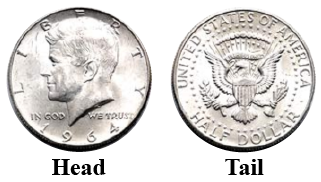
There are always two sides to a coin- Heads and Tails.
Have you ever fabricated an of import decision by flipping a coin?
In American football, the captain of each team chooses a side of a coin and and then the referee tosses the money.
The helm who predicts the toss correctly decides about the goal which his team would defend.
Let u.s. come across how this works and what is the probability of each side of a coin.
Lesson Programme
What Are the Possible Events that Can Occur When A Money Is Tossed?
Every coin has two sides: Head and Tail
We denote Head every bit H and Tail as Tail.
When a coin is tossed, either head or tail shows up.
The set of all possible outcomes of a random experiment is known as itssample infinite. Thus, if your random experiment is tossing a coin, so the sample space is {Head, Tail}, or more succinctly, {H,T}.
If the money is fair , which means that no issue is especially preferred, or every consequence is equally likely , and so we know that for a big number of tosses, the number of Heads and the number of Tails should be roughly equal. That is, the number of Heads should be roughly 1/2 of the total number of tosses, so should be the number of Tails. This numerical quantity of one/2 can be used as a measure of likelihood , or probability .
What Do You Hateful by Tossing A Coin Probability?
Tossing A Coin Probability is the chance of each side of the coin to bear witness up.
The action of tossing a coin has two possible outcomes: Head or Tail. You don't know which outcome you lot will obtain on a particular toss, but you practise know that it will be either Head or Tail (we rule out the possibility of the coin landing on its border!).
Contrast this with a science experiment. For example, if your experiment is to driblet an object, you lot know the effect for certain: the object will fall towards the ground. However, tossing a money is a random experiment , as y'all do know the set up of outcomes, only you do not know the exact event for a detail execution of the random experiment.
The general formula to decide the probability is:
\(\text{Probability }= \dfrac{\text{Number of favorable Outcomes}}{\text{Total number of outcomes}}\)
When a coin is tossed, there are only 2 possible outcomes.
Therefore, using the probability formula
On tossing a coin, the probability of getting a head is:
P(Head) = P(H) = 1/2
Similarly, on tossing a coin, the probability of getting a tail is:
P(Tail) = P(T) = 1/2
Try tossing a coin below by clicking on the 'Flip coin' push and cheque your outcomes.
Click on the 'Reset' button to start again.
How Practice You lot Predict Heads or Tails?
- If a coin is fair (unbiased), that is, no result is particularly preferred, then we cannot predict heads or tails. Both the outcomes are as likely to testify up.
- If a coin is unfair (biased), that is, an outcome is preferred, and so nosotros tin predict the outcome past choosing the side which has a higher probability.
- If the probability of a head showing up is greater than 1/2, and so we can predict the next outcome to be a caput.
- If the probability of a tail showing upward is greater than ane/2, then nosotros tin predict the next outcome to exist a tail.
Suppose that yous toss a coin 100 times. Which of the following results ismore than likely to occur?
Result-i: You obtain 95 Heads and five Tails
Result-two: You obtain 48 Heads and 52 Tails
If the money is a normal everyday coin, in which neither side is particularly prone to showing up more than the other side, yous would expect that in a large number of tosses, Heads and Tails should show upward roughly an equal number of times. This ways that out of the two results above, Consequence-2 seems to be the more probable ane, as the number of Heads is roughly equal to the number of Tails, which concurs with the fact that neither Head nor Tail is a preferred outcome.
On the other hand, in Result-1, the number of Heads is much larger than the number of Tails. Clearly, such a result is extremely biased towards Heads, which is not very likely given that Heads and Tails are equally preferred outcomes. Note that we are not saying that Result-1 is incommunicable. We are only saying that it is improbable , or unlikely . In other words, the likelihood of Outcome-one is much lower than the likelihood of Issue-ii.
The study of Probability enables the states to quantify likelihoods. It enables us to answer questions like: How likely is Result-2? How unlikely is Result-1? And and then on.
However, tossing a coin is a random experiment , every bit you do know the set of outcomes, but yous practise not know the exact outcome for a particular execution of the random experiment.
Solved Examples
A coin is tossed a certain number of times. The relative occurrence of Heads is 0.75. Can nosotros say that the coin is biased towards Heads?
Solution
No, we cannot, because the experiment (tossing the coin) may accept been repeated a very small number of times, and thus the relative occurrence in such a scenario will not give the true probability.
Coin-A is tossed 200 times, and the relative occurrence of Tails is 0.47. Money-B is tossed an unknown number of times, just information technology is known that the relative occurrence of Heads is 0.l. Which money is fairer?
Solution
It is non possible to comment on the fairness of Money-B, because the number of times it was tossed is non known. On the other manus, Coin-A seems to be fair, equally the relative occurrence of tails over a big number of tosses is most 1/two.
On tossing a coin twice, what is the probability of getting only one tail?
Solution:
On tossing a coin twice, the possible outcomes are {HH, TT, HT, TH}
Therefore, the total number of outcomes is 4
Getting only one tail includes {HT, TH}
Therefore, the number of favorable outcomes is 2
Hence, the probability of getting exactly i tail is 2/4 = i/ii

- Relative occurrence of an issueis used to signify the ratio of the number of times that a particular event is obtained to the total number of times the random experiment is performed.
- On tossing a coin, the probability of each consequence is ane/2
- P(Caput) + P(Tail) = 1
Interactive Questions
Hither are a few activities for yous to do.
Select/Type your answer and click the "Bank check Answer" push button to see the issue.

Challenging Questions
- A fair coin is tossed repeatedly. If the tail appears on the kickoff 4 tosses, then what is the probability of the head appearing on the fifth toss?
- If a coin is tossed thrice successively, what is the probability of obtaining at least one head and at least ane tail?
Let'due south Summarize
We promise you enjoyed learning most Tossing A Money with the simulations and practice questions. Now you volition be able to easily solve problems on Tossing A Coin math with multiple math examples you lot learned today.
About Cuemath
At Cuemath, our team of math experts is dedicated to making learning fun for our favorite readers, the students!
Through an interactive and engaging learning-didactics-learning approach, the teachers explore all angles of a topic.
Be it worksheets, online classes, dubiousness sessions, or any other form of relation, it's the logical thinking and smart learning approach that nosotros, at Cuemath, believe in.
Frequently Asked Questions (FAQs)
1. Can a coin land on its side?
A coin can country on its side if information technology falls against an object such as a box, shoe, etc.
It is unlikely for a coin to country on its side on a flat surface, but nosotros cannot say that it is impossible.
2. Is flipping a coin a good fashion to brand a decision?
Making decisions by flipping a coin helps a person to decide when stuck between two options because each consequence has an equal probability.
3. How do you predict a coin flip?
Tossing a coin is a random experiment, as you do know the set of outcomes, just yous do non know the exact outcome for a particular execution of the random experiment.
Therefore, we cannot predict a coin flip if the money is fair.
4. Are money flips truly random?
Tossing a coin is considered a random issue.
According to Newton, if a person flips in a item manner at a definite speed, then the result tin be determined.
five. What is the probability of flipping five heads in a row?
On tossing a coin five times, the number of possible outcomes is 25
Therefore, the probability of getting five heads in a row is 1/25
half-dozen. Is flipping a money a simple random sample?
Simple Random Sample takes a small portion of a large dataset to represent the data.
Tossing a coin is a random experiment and each outcome has equal probability.
Therefore, tossing a coin is a simple random sample.
seven. Is a coin toss actually 50/50?
On tossing a coin, each outcome has an equal probability and there are two outcomes.
Therefore, tossing a money a 50/50.
viii. In a coin toss, is it fairer to grab a coin or let information technology fall?
On tossing a coin, information technology is fairer to permit the money autumn than catching it because the force of the hands can flip it.
9. What are the odds of flipping three heads in a row?
On tossing a money three times, the number of possible outcomes is twoiii
Therefore, the probability of getting five heads in a row is 1/2iii

Source: https://www.cuemath.com/data/tossing-a-coin/
Posted by: harperprient.blogspot.com
0 Response to "Will A Coin Grading Service Clean The Coins First"
Post a Comment